Kat Zet I
The Zone of InterestKat Zet I, also called KL1 and the Stammlager, is the camp location where the book’s routines of selection, forced labor, and command repeatedly converge. Its defining geography is not only the ramp and work sites but also the route from arrivals to the killing sites, the polluted landscape that surrounds them, and, finally, the place where Paul Doll is executed. Through that geography, the camp’s claims to order and productive purpose are set against the bodies, odors, and deaths that make its operation possible.
Setting and Function
Kat Zet I belongs to a larger camp complex: the ramp is where arriving transports are unloaded and selections are made, before a further drive through the birch wood to the Little Brown Bower in Kat Zet II. Boris Eltz describes ramp duty as punishment within a punishment: a month assigned there after yet another fistfight. The detail makes the ramp both a working station in the camp’s process and a disciplinary posting for the men who administer it. Boris calls the selection its eeriest part and invites Doll to witness it, treating an organized act of terror as an experience to be observed.
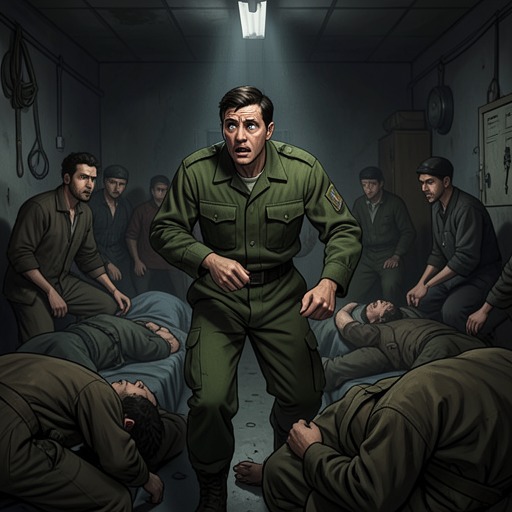
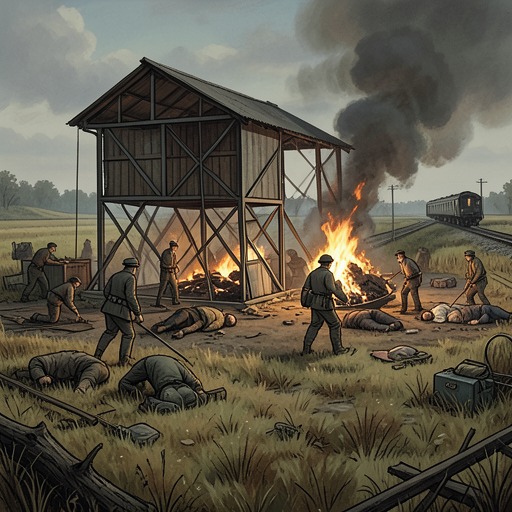
The camp’s relationship to the neighboring killing site is made brutally visible when a truck carrying the day’s dead from Kat Zet I toward Kat Zet II breaks down in front of a group of visitors. Doll recognizes the load as familiar, while the visitors recoil and Boris turns to look at him. Doll responds by directing the musicians to play: the music first echoes the group’s helpless cry, then accompanies their walk onward as the truck disappears. The interruption does not stop the transport or alter its destination. Instead, it shows how performance and command can briefly manage what the visitors see without changing the system that produced it.
Landscape, Smoke, and Contamination
Spring Meadow makes the camp’s violence perceptible beyond what can be seen. Returning to Sector 4IIIb(i), Doll realizes that the meadow can be heard from the mound where Wolfram Prufer, Stroop, and Erkel stand: it pops, splatters, and hisses. Its smell is already present. Doll insists to himself that he feels no false sentimentality, and invokes Germany and its leader to recast kindness as disloyalty. His reasoning exposes the moral conversion on which his role depends: actions are no longer judged as good or bad, but as having positive or negative outcomes under the regime’s order.
The environmental consequences also enter conversation as an administrative problem. After a meeting with local figures in Old Town, Doll tells Prufer that the water is undrinkable despite repeated boiling, that the pieces have begun to ferment, and that the water table has been breached. He anticipates an overwhelming smell rather than proposing that the underlying process stop. On another drive back, after benzene tanks have been loaded and the required receipt obtained for 1,800 zlotys, Doll repeatedly pulls over to sniff the air and finds the stench worsening. The camp’s pollution is not an incidental atmosphere: water, air, and the landscape carry the consequences of what its administrators do.
Work, Routine, and Denial
Kat Zet I is linked in the narrative to the industrial world of the Buna-Werke. From an office window there, Doll watches not only prisoners moving in lines and Kapos and SS noncommissioned officers shouting at them, but also designers, engineers, and administrators from IG Farben plants in Frankfurt, Leverkusen, and Ludwigshafen. These company representatives pick their way past the wounded, unconscious, and dead with notebooks and measuring tapes. The contrast places technical inspection and commercial administration beside the human cost of the labor system they oversee.
Doll’s account of camp routine turns this coexistence into a repeated daily sequence: reveille, washroom, roll call, work teams, the brass band, and selection, alongside dysentery, the yellow star, and the crematoria. Such listing makes the camp’s violence appear embedded in ordinary procedure, not separate from it. Yet the narrative repeatedly breaks through that procedural language with physical evidence: the sound from Spring Meadow, the smell that worsens on the road, and the brown snow that Doll later asks himself why they have made. At the Officers’ Club after the November 9 memorial observance, amid the banquet’s leftovers, he poses questions about the meadow, the smell, drunkenness on the ramp, disease, and the deaths of women and children. The site’s atmosphere becomes an indictment that his official vocabulary cannot contain.
Administration and Aftermath
Kat Zet I is also a place of personal and political entanglement. At dusk Doll goes to Ilse Grese’s cubicle in Kat Zet I; elsewhere, his recollection of Christmas walks with Gerda Bormann turns the image of camp surroundings against private longing, as he imagines Hannah in Gerda’s place. These relationships do not soften the camp’s function. Rather, they show how the perpetrators’ private attachments and self-conceptions persist alongside the system they serve.
The camp’s final significance is made explicit in the fate of its commandant. Doll was moved sideways in June 1943 to a clerical position at the Inspectorate of Concentration Camps in Berlin and reinstalled as commandant in May 1944. Captured in March 1946, tried at Nuremberg, and delivered to the Polish authorities, he was hanged outside Bunker 11 in Kat Zet I on April 16, 1947. The location that had organized other people’s confinement and death became the site of his execution. In the postwar discussion of reparations for murdered relatives, years lost to slavery and terror, and lasting physical and mental injury, the camp’s consequences extend beyond its gates: its geography remains inseparable from the lives and losses for which justice was sought.